
Coherence Is the Zoo
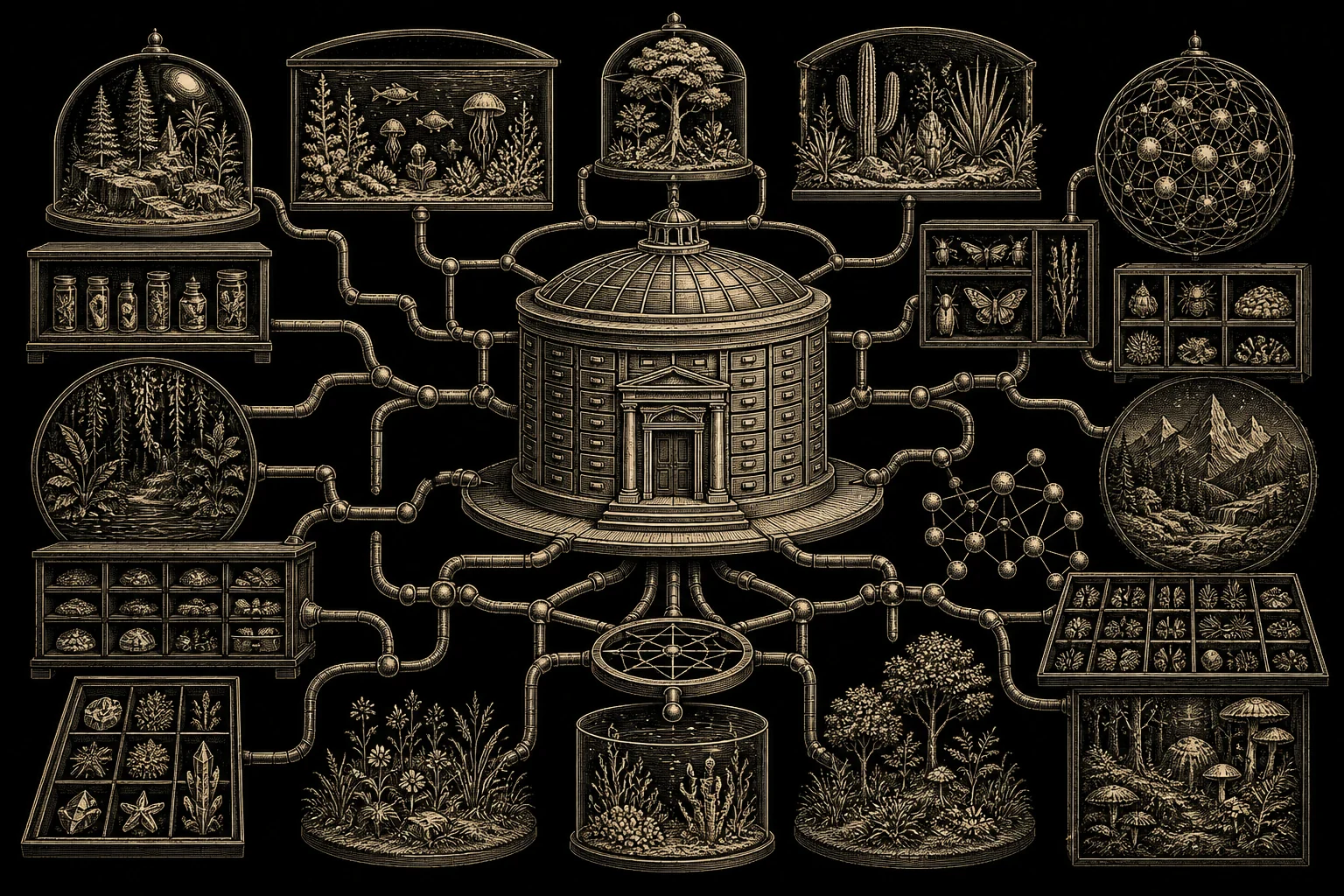
A zoo is organized, but every animal remains different. Good data architecture should do the same: create order without erasing useful differences.
There is a thought experiment in conservation biology that data architecture has not borrowed yet, and it should.
If you reduced Earth’s biosphere to a single representative species per functional category, selecting for whatever you decided to call optimal, the system would not become leaner or more efficient. It would collapse. Not because the eliminated species were redundant. Because ecosystems run on relationships, not species counts. The complexity that appears to be waste is actually the load-bearing architecture.
We are running this experiment on enterprise data. And we are calling the results maturity.
Commercial Cavendish production relies heavily on closely related triploid somatic clones. The genetic base is narrow, and the options for introducing variation are limited. That does not mean every Cavendish plant is literally identical, but it does mean a pathogen that succeeds against the dominant lineage can travel unusually far. Resilience requires variation, and variation is often the first casualty of an efficiency optimization. Population-genomics research on banana varietal lineages documents both the clonal structure of commercial Cavendish production and the limited routes through which new diversity enters it.
Platform consolidation can produce the same failure mode. What disappears first is often the specialist context. Operational records survive migrations because they are legible and portable. What gets cut are the behavioral signals with embedded contextual logic and the relational metadata encoding institutional history. They resist standardization and the migration is on a deadline, so they go. Without an explicit mechanism to preserve that knowledge, it does not simply re-emerge later.
I have sold source-of-truth architecture and I believe in it. But that is not a contradiction.
Think about a zoo. A zoo exists to maintain diversity under conditions that can no longer sustain it in the wild. The public-facing layer generates the revenue that protects what it contains. A zoo without animals is a parking lot. A source-of-truth layer is legitimate when it translates structural diversity without flattening what produced it. It becomes a failure mode when it is used to justify the habitat destruction it was supposed to be managing.
Too many consolidation programs do the second thing and call it the first.
Coherence is the zoo. Uniformity is the parking lot.