Data Architecture.
We organize and repair data, move it safely, connect systems, and build structures that stay reliable.
Explore

Data, information, and AI should work together, not become three separate projects.
Data holds the facts. Information gives those facts meaning. AI helps people use what they know. We design all three as one connected system.
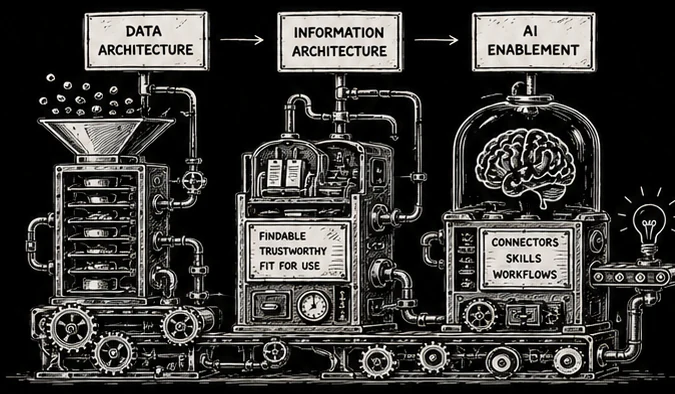
AI works only as well as the data and information it receives. If either is unreliable, the result will be unreliable too.
Data architecture keeps data accurate, secure, and ready to use.
Information architecture organizes that data so people and systems can find it and understand it.
Connections give approved tools access to what they need while keeping everything else protected.
Capability Bundles give AI the instructions and tools it needs to perform repeatable work.
AI Work Systems coordinate that work across people, roles, departments, and AI.
Enterprise Intelligence Architecture connects every part into one working system.
Each step depends on the ones before it. Weak data or confusing information makes every later step less reliable.
We organize and repair data, move it safely, connect systems, and build structures that stay reliable.
ExploreWe organize files, metadata, and knowledge so people and systems can find, trust, and use them.
ExploreWe connect AI to the right information, instructions, and workflows so it can perform real work safely and consistently.
ExploreCross-Practice Architecture
Business definitions, data models, reports, documents, permissions, search, workflows, and AI often live in separate systems. We connect them so the organization can work from shared information and clear rules.
You can start with one area, or we can assess, design, and build the complete environment.
Explore Enterprise Intelligence Architecture
Every potential project starts with free scoping. We study the problem, recommend the next step, and give you an early estimate of the work.
If a reliable answer requires deeper research or a formal roadmap, we explain that work and its cost before anything begins.
Start with free scoping