

“It’s Just Moving Data” (and Other Things That Aren’t)
A successful migration can look easy. That ease comes from careful decisions no one sees.
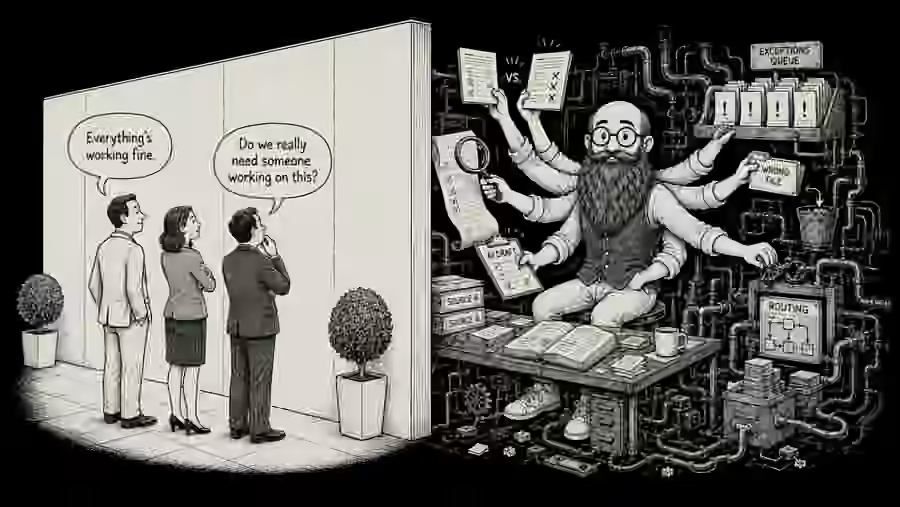
The Objection
I have been doing versions of the same work for most of my career, and for most of my career I have been answering the same question. Early on it was data. Why is the migration taking so long, it is just moving data, pick it up here and put it down there. Later it was systems. Is this not overcomplicated, do we really need all of that. Now it is AI. Why does the thing need to check its own work, why does it generate its own guiding documents, why does it need alignment on how it behaves, are you not overbuilding this.
The object keeps changing. The objection does not. And after enough years you stop hearing it as a question about the specific task and start hearing it as one continuous confusion, wearing whatever costume the decade hands it.
The confusion is not stupidity. Some of the people asking are the sharpest people in the room. It is something more interesting than that, and David Hume described it nearly three hundred years ago without ever seeing a database.
The Invisible Cause
Hume noticed something unsettling about how we understand cause and effect. We never actually perceive necessity itself. We see one thing, then another, and through repetition the mind learns to expect the second from the first. The billiard ball strikes the second ball, the second ball moves, and we say the first caused the second. But we did not observe the causing. We observed a before and an after, and the connection between them is something the mind supplies, not something the eye was given.
Hold that next to a piece of work done well.
The client sees the data sitting in the old system. Then the client sees it living correctly in the new one. What the client does not see, because it was never available to be seen, is the reconciliation of three contradictory definitions of a single field, the discovery that two departments had been quietly meaning different things by the word "closed" for six years, the decision about which of two conflicting records was the truth, and the two hundred smaller decisions like it. Get one of those decisions wrong and a client's entire matter history can end up silently attached to the wrong file. The client will never see that the decision was there to be made. They will only ever see that it went right, or one day that it went wrong.
So the client does what the mind always does. Sees the before, sees the after, and infers a simple connection, because a simple connection is the only thing the senses were offered. The work was invisible, so the work looks trivial. Not because the client is careless, but because the connection between before and after is precisely the part perception does not hand us. Someone has to reconstruct it.
A lawyer already knows this in their own domain, they have just never had it named. The brief that reads as though the conclusion were obvious is the brief that took the most work. The argument that flows so cleanly the judge nods along is concealing the forty hours of research that got cut, the three lines of reasoning that were tried and abandoned, the single case that reframed the whole thing found at eleven at night. Opposing counsel sees a tidy six pages and thinks it was easy. The ease is the achievement. The work is precisely the part that does not appear on the page.
That is the first move. The work connecting before to after is invisible, so the effort reads as small.
The Habit
Hume's second observation is worse, because it explains why this problem grows instead of shrinking.
We come to expect effects to follow their causes, he said, through nothing more than repetition. See it happen enough times and the expectation hardens into something that feels like a law of nature. The sun has risen every morning of your life, so you do not experience tomorrow's sunrise as a probability. You experience it as a certainty you never think about. The repetition did that. The habit became invisible to itself.
Now apply that to a system that works reliably.
The first time the automated process delivers the right answer, someone is mildly impressed. The tenth time, it is expected. By the hundredth time, the correct answer simply appears, the way the sun comes up, and no one in the building can any longer remember that appearing was ever in question. The reliability you worked hardest to build is the exact thing that trains everyone around it to stop seeing that anything is being done at all.