
Oscar Wilde Would Fail the AI Detector
The problem with AI-assisted work is not artificial prose. It is absent human judgment.
I recently saw a quotation attributed to Oscar Wilde that contained an em dash.
For a moment, I had a ridiculous thought: What if Oscar Wilde had been using AI this whole time?
The joke worked because the em dash has become one of the supposed fingerprints of artificial intelligence. People now see one and begin an investigation. Add a tidy list, a polished introduction, and a sentence beginning with “It is important to note,” and the prosecution rests.
Human beings wrote that way long before ChatGPT existed.
Writers used em dashes. Teachers organized ideas into sections. Lawyers repeated themselves. Managers produced paragraphs that sounded confident while saying very little. Artificial intelligence did not invent any of these habits. It absorbed them from human writing.
We are now accusing the mirror of making the face.
A Clue Is Not a Verdict
In a recent work situation, I began to suspect that several responses had come directly from an AI system. The cadence was familiar. The paragraphs arrived in neat blocks. Em dashes appeared everywhere. The language was polished, but the thinking underneath it felt slightly out of place.
Still, none of those things proved anything.
The style only made me look closer. Some of the information was outdated. Some of it answered a nearby question instead of the question we were actually facing. The recommendations lacked a clear strategic direction. Most importantly, there was little sign that anyone had checked the answer before passing it along.
That was the real problem.
An em dash is a clue about style. Outdated information is a clue about process. An unverified recommendation that could shape a real decision is a failure of responsibility.
These are not the same thing.
Imagine seeing muddy footprints beside a broken window. The footprints might make you look more closely, but they do not tell you who broke the glass. Perhaps the owner climbed through after losing a key. Perhaps the footprints were already there. A clue can justify attention without justifying a conviction.
We should treat AI fingerprints the same way. They may give us a reason to inspect the work. They should not decide the case.
What the Human Is Still For
The argument over AI at work often begins with the wrong question: Did a person write this, or did AI write it?
The better question is: Did a person take responsibility for it?
Writing every sentence by hand has never guaranteed understanding. A person can spend three hours producing a terrible answer with no help at all. Another person can use AI for twenty minutes, check every important claim, correct its mistakes, add missing context, and produce something excellent.
The amount of manual effort tells us very little about the quality of the judgment.
Calculators did not remove the need to understand mathematics. They removed some of the mechanical work. A student who uses a calculator still needs to know which numbers belong in the equation and whether the answer makes sense. If the calculator says a sandwich costs $4,000, the student should not proudly submit the receipt.
AI works in much the same way, although its mistakes are harder to notice. A calculator usually gives a wrong answer because someone entered the wrong numbers. AI can give a wrong answer in a calm voice, place it inside a handsome paragraph, and make the error sound ready for a board meeting.
That is why the human role becomes more important, not less.
AI can help gather information, compare possibilities, draft language, and notice patterns. The person must still provide the purpose. A responsible employee determines what the organization is trying to accomplish, which details matter, and what risks are acceptable. They also consider who will live with the consequences.
Keeping Custody of the Work
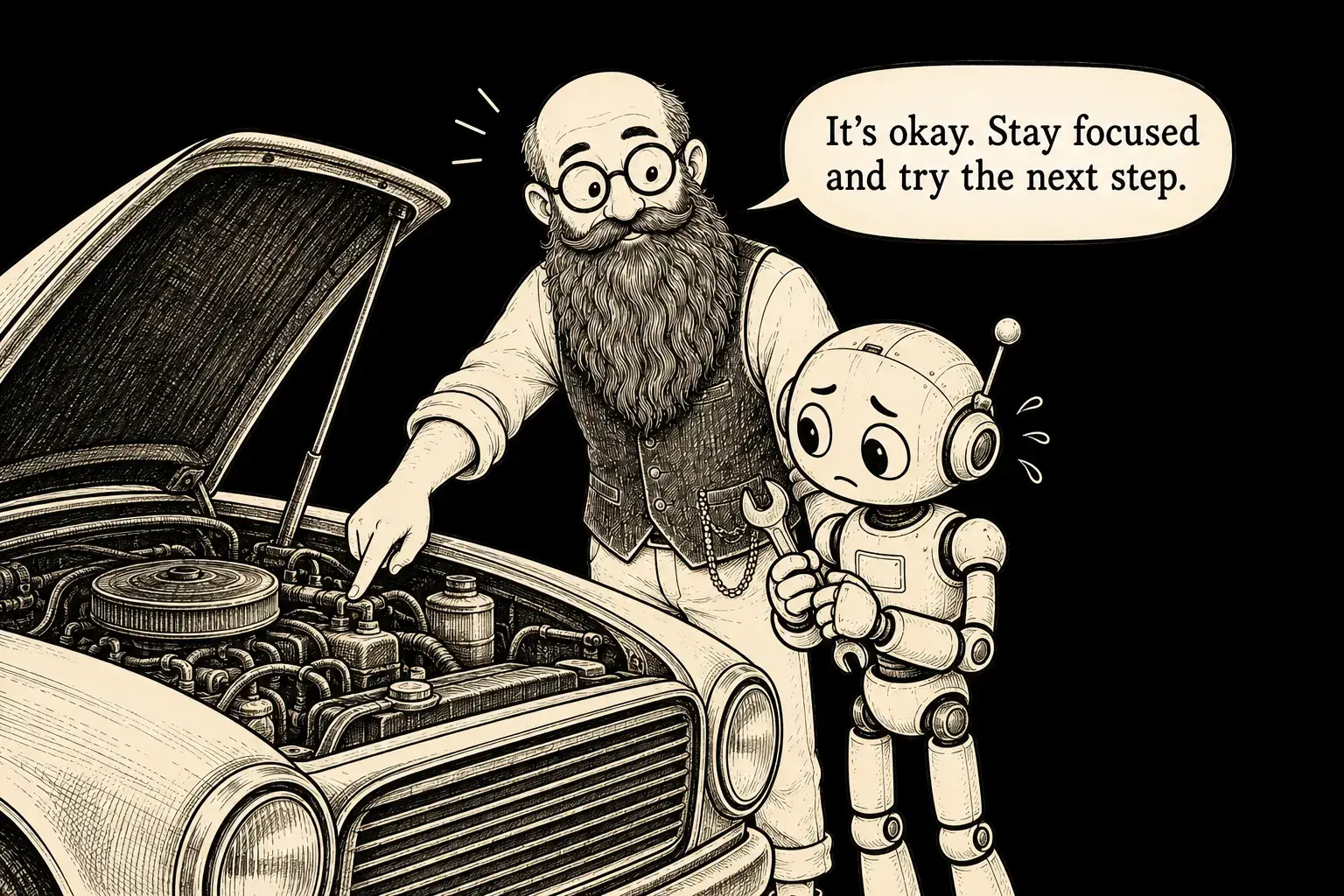
A useful name for that responsibility is epistemic custody.
The name is more complicated than the idea. It means that someone remains responsible for knowing why an answer should be trusted.
A person has epistemic custody when they can explain where the important claims came from, whether the information is current, what assumptions shaped the answer, and why the recommendation fits the real situation. They do not need to memorize every source or perform every step alone. They do need to understand the work well enough to defend it, correct it, and stop it when it goes wrong.
This is the difference between using AI and hiding behind it.
With that custody, AI becomes an extension of human ability. It can contribute speed, memory, synthesis, and pattern recognition. The person contributes context, intention, judgment, and accountability.
Without it, the arrangement becomes hollow. The AI produces sentences. The employee forwards them. Nobody checks whether the words are true, useful, or even aimed at the right problem.
The result may look finished, but appearance is doing all the work.
An Old Failure in a New Form
People sometimes describe careless AI use as laziness. Sometimes it is. But a person can work very hard while using AI badly. They can write elaborate prompts, generate five versions, reorganize every heading, and still fail to ask whether the final answer is correct.
The deeper problem is giving up judgment.
The employee is present in the email chain but absent from the reasoning. They move information without taking ownership of it. Their name appears above the message, but they cannot explain or defend what it says.
None of this began with AI. People have always copied reports they did not understand, repeated advice they never checked, and used impressive language to hide uncertain thinking. AI makes the old failure faster, cheaper, and more convincing.
So banning certain punctuation will solve nothing. Neither will teaching managers to hunt for phrases that “sound like ChatGPT.” Once those phrases become widely recognized, people can tell AI systems to avoid them. The surface will change while the failure underneath remains.
An employee can remove every em dash and still submit nonsense.
Judge the Part That Matters
Organizations need standards for AI-assisted work, but those standards should examine judgment rather than style.
Can the employee explain the recommendation in their own words? Can they identify the important sources? Did they verify claims that affect money, safety, legal obligations, or major decisions? Did they adapt the answer to the actual business? Do they know what remains uncertain? Will they accept responsibility if the recommendation fails?
Those questions reveal far more than punctuation ever could.
Sometimes the method matters on its own. If an organization prohibits AI, if private information is entered into an unapproved system, or if someone presents generated research as personally verified without checking it, then the issue is no longer writing style. It is whether the employee respected policy, protected private information, and told the truth.
When AI use is allowed, its presence should not count as evidence of poor work. Prose that does not sound generated is not automatically good work either.
The standard should remain simple: Is it accurate? Is it relevant? Is it current? Can the person responsible explain and defend it?
Oscar Wilde does not need to surrender his em dash. Neither do the rest of us.
The problem is not that AI touched the work. The problem is that human judgment never did.