Insights

The Architecturally Intelligent Business

The next stage of business AI is not more tools. It is designing how intelligence works across the organization.

By Kevin Monceaux10 min read
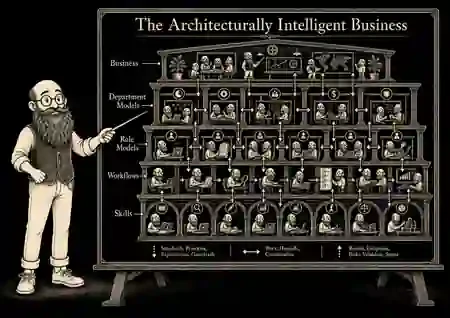
The Architect presents a nested model of an architecturally intelligent business, from skills and workflows through role models, department models, and business-level governance.

Businesses are rapidly moving from a handful of AI tools to an expanding number of AI-enabled capabilities spread across roles, systems, and departments.

At that point, the problem changes.

It is no longer simply how to use AI. It is how to organize it.

An assistant helps write something. An agent handles part of a process. A workflow is automated. A model is connected to company information. Each can create value, but without a larger structure, they can also become another collection of disconnected tools.

We believe the next stage of AI in business will be architectural.

Not just the technical architecture behind AI.

The operating structure of the business itself.

The goal is to design organizations in which people, software, automation, and AI can work through a shared structure with clear responsibilities, behaviors, standards, boundaries, and ways of coordinating with one another.

We think of this as an architecturally intelligent business.

And there is one distinction at the center of that idea:

Knowing what a business knows is not the same thing as knowing how the business should behave.

AI needs both.

That behavioral layer is the spine of the architecture. Skills define bounded behavior. Workflows coordinate it. Role Models define how a job function should behave. Department Models coordinate and govern behavior across roles. At the business level, broader priorities, standards, and guardrails shape how departments operate together.

It Starts With Skills

At the implementation level, the smallest reusable unit in this architecture is a skill.

A skill is a bounded operational capability designed to perform a specific kind of work. It might help find the right information, review a document, prepare an analysis, generate something from approved sources, validate work, identify an exception, or complete part of a larger process.

The important part is not simply that an AI model is capable of doing the task.

The behavior has to be defined and bounded.

We approach that design as a research-informed problem, not a prompt-writing exercise. Academic frameworks from behavioral science, organizational behavior, human factors, and systems thinking provide disciplined ways to define expectations, observe outputs, apply feedback, evaluate behavior against standards, and improve it over time.

A skill needs clear rules for which information to use, what standards apply, what it is allowed to do, what a good result looks like, what permissions and authority it has, and when human review is required.

That turns AI from a general-purpose tool into an operational capability.

Several skills, together with human or deterministic steps where appropriate, can then be coordinated into a larger workflow.

That is where the architecture begins to matter.

A Job Is More Than a Collection of Tasks

Most jobs are not one task. They are patterns of behavior.

A person in a role learns what information to look for, what standards to apply, which problems require attention, when something is wrong, what can be corrected, what requires approval, and when work needs to move to someone else.

Much of that knowledge never appears in a job description. It lives in processes, documents, systems, experience, and very often in people's heads.

AI creates an opportunity to make more of that operating knowledge explicit.

That leads to what we call a Role Model.

A Role Model is not an AI pretending to be an employee.

It is a structured operating definition for a job function.

It defines the responsibilities of the role and gives its skills the context, standards, boundaries, and operating rules needed to perform work consistently. In that sense, a Role Model is the behavioral operating definition for the job: it defines how the function is expected to act, decide, check, escalate, and hand off work.

An AI agent may be able to take actions, coordinate tasks, or work toward an outcome. The Role Model defines how that work is expected to fit into the job.

An agent is one way that work can be carried out within that structure.

A person may perform some of the work. An agent may perform or coordinate other parts. Conventional software or deterministic automation may handle still more.

That separation matters because the organizational structure should be more durable than the technology executing through it.

The operating model should outlast the technology used to execute it.

AI models and platforms will change quickly, but a well-understood operating model for a business role should not have to be rebuilt every time the underlying technology changes.

Roles Can Be Used in Different Ways

Once a role has been modeled, a business does not have to choose between "human" and "AI."

That is too simple.

The same operating structure could support a person doing the work with AI assistance. Individual skills could be triggered when needed. Certain workflows could run automatically when specific conditions are met. An agent could work through several workflows.

As these structures mature, they can also be organized around outcomes rather than individual tasks, allowing the appropriate roles, workflows, and capabilities to participate as needed.

The architecture stays consistent even when the method of execution changes.

That gives businesses room to automate carefully rather than treating automation as an all-or-nothing decision.

Departments Need Behavior Too

Individual roles do not operate alone. They depend on one another.

Work moves between them, information crosses boundaries, standards apply across multiple roles, and one person's exception may become another person's responsibility.

That means a department needs more than a collection of intelligent roles.

It needs coordination.

We call that a Department Model.

A Department Model is the shared operating layer that coordinates work across roles.

It can establish common standards, help determine how work should move between roles, apply shared guardrails to the work performed within the department, and review, challenge, validate, correct, or escalate work based on department-level expectations.

It can also turn activity across many roles into something leadership can actually understand.

In simple terms, the department layer begins to provide some of the behavior we normally associate with management.

Not because AI becomes "the manager," but because management itself contains repeatable operating behaviors.

Managers establish standards, review work, resolve conflicts, identify exceptions, coordinate people and resources around outcomes, and determine what requires attention versus what can continue without intervention.

Some of those behaviors can be made explicit and supported by technology. The same research-informed behavioral discipline applies here: define expectations, observe what happens, compare it against standards, correct where authority allows, and escalate where human judgment belongs.

That is very different from simply putting several agents in the same system and calling it an AI department.

The Same Pattern Can Continue Upward

A business works through layers.

Skills provide bounded operational behaviors. Skills, together with human or deterministic steps where appropriate, participate in workflows. Role Models define how job functions are expected to operate. Department Models coordinate the work of multiple Role Models and apply shared standards and guardrails across them. At the business level, broader priorities, expectations, and standards can guide how departments operate together.

Behavior is the spine all the way up the chain.

At each level, there are behaviors that belong to that level.

A role may validate the work produced by one of its skills. A department may determine whether several roles are working together correctly. At the business level, broader standards, priorities, and guardrails can guide how departments operate together.

This creates a nested operating structure for intelligence.

Higher levels do not need to perform every task themselves. Instead, they can establish the rules, priorities, expectations, and constraints that guide the levels below them.

Direction and standards can move downward.

Work, decisions, handoffs, and coordination can move across the organization.

Results, exceptions, risks, and important changes can move upward.

The result is not simply a hierarchy.

It is a coordinated system of behavior.

This Is About Behavior, Not Just Information

Businesses have spent years organizing information. They build knowledge bases, connect systems, centralize data, and document processes.

Those things are essential.

But there is a difference between organizing what a company knows and organizing how it operates.

Knowing what a business knows is not the same thing as knowing how the business should behave.

An intelligent organization needs both.

It needs access to the right information, but it also needs clear ways to search for that information, determine which sources should be trusted, apply the right standards, judge an output, handle conflicting information, correct problems, and determine when a human needs to make the decision.

That behavioral layer is where AI becomes much more interesting.

Research-informed does not mean turning the business into an academic exercise. It means bringing more discipline to how behavior is designed: using established ways of thinking about context, rules, feedback, human factors, organizations, and systems instead of leaving behavior implicit in a prompt.

The goal is to make more of the organization's operating behavior explicit enough that people and technology can work through it consistently.

AI Cannot Be Separated From the Business Around It

None of this means the underlying technology stops mattering.

Quite the opposite.

Reliable AI operation depends on having the context, access, constraints, and authoritative information appropriate to the work.

If company information conflicts, there needs to be a way to determine which source governs. If systems are disconnected, understanding what should happen is not enough to make it happen. If permissions are unclear, giving AI more access can create more risk rather than more intelligence.

And if standards exist only in someone's memory, there is nothing reliable for an automated system to enforce.

That is why meaningful AI integration eventually touches data, information, systems, permissions, governance, and business processes.

AI does not simply sit on top of a company.

It operates through the company.

The quality of that environment determines how far intelligent automation can safely go.

The Goal Is Not Maximum Automation

The goal is not to automate everything that can possibly be automated.

It is to determine where different kinds of capability belong.

Some work benefits from human judgment.

Some benefits from AI assistance.

Some can be executed by agents with oversight.

Some should remain ordinary software automation.

Some should remain deterministic because AI would add uncertainty without adding useful intelligence.

The architecture should make those choices intentionally.

Done well, this can increase the amount of work an organization can handle without requiring complexity to grow at the same rate.

People can spend less time reconstructing information, repeating routine steps, checking work that can be checked automatically, and manually coordinating processes the organization already understands.

Managers can spend less time collecting status and more time making decisions.

Organizations can preserve operating knowledge that might otherwise disappear when experienced employees leave.

Leadership can gain a clearer view of what is happening across increasingly complex operations without personally managing every individual task.

From AI Tools to an Intelligent Organization

Much of the first wave of business AI focused on access: giving people better tools.

The current wave is increasingly about action: workflows and agents that can perform real work.

The harder problem now is organization.

How should these capabilities work together?

Who defines their standards and boundaries?

How should work, decisions, and exceptions move through the organization?

And how do we keep the operating model stable while the technology underneath it continues to change?

Those are no longer questions about an individual AI tool.

They are questions about how the business itself is designed.

Skills provide bounded behaviors.

Those skills participate in workflows alongside human or deterministic steps where appropriate.

Role Models define how job functions are expected to operate.

Department Models coordinate the work of multiple Role Models and apply shared standards, guardrails, and management behavior across them.

At the business level, broader priorities, expectations, and standards can guide how departments operate together.

People, agents, automation, and conventional software can then carry out work through that structure in different combinations depending on what the work actually requires.

AI has not become the organization.

The organization has become better able to express how it should operate.

Once those behaviors, responsibilities, standards, and relationships become explicit, intelligence can participate in the business at a much deeper level than an assistant sitting beside an employee.

It becomes part of the way the organization works.

That is what we mean by an architecturally intelligent business.

We believe this is where enterprise AI is heading: away from isolated tools and toward intelligence designed into the operating structure of the business itself.

Assessment

Know the work before you commit to it.

Start with a free assessment