
We Don’t Need AI (and Other Things We’ve Said Before)
New technology often produces panic or blind excitement. Understanding what AI can and cannot do is the first step toward using it wisely.
The more time I spend helping people build AI workflows, the more I encounter the same obstacle, and it is rarely just the technology.
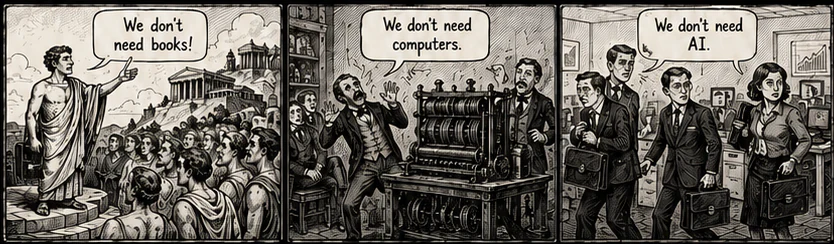
I made the accompanying illustration with AI, which is either the joke or the point. Its three scenes are deliberate caricatures, not historical quotations: a man in a toga dismisses books, Victorian clerks recoil from a calculating engine, and office workers mutter that they do not need AI.
The objection never changes. Only the object does.
It is worth asking why the objection recurs. The usual reading is that people simply fear change, but that flatters no one and explains very little. The fear is not stupid. A new technology can threaten status, income, identity, and a hard-won sense of competence. But a threat response compresses a slow structural shift into an immediate emergency, and emergencies reward reaction more readily than study.
Most versions of this argument now pivot to reassurance. Adapt and you’ll be fine. I won’t sell you that, because it isn’t true, and the people telling you it’s true are usually selling something.
The refusers are not always wrong. The people who warned about leaded gasoline were right. The Luddites were responding to real damage to skilled work, bargaining power, and wages, not merely displaying an irrational hatred of machines. New technologies genuinely destroy some livelihoods, and they do so for a specific person, at a specific age, with a specific mortgage, while many of the benefits land somewhere else. Waving that away is not optimism. It is distance.
What refusal gets wrong is not the cost. It is the belief that disengagement avoids the cost. It rarely does. The transition continues while the person standing outside it gives up the chance to understand where the tool is useful, where it fails, and how their own judgment might become more valuable.
Earlier transitions often changed the level at which valuable work happened. Writing expanded the work of scholars, lawyers, and archivists. Mechanical and digital calculation reduced some forms of manual processing while expanding analysis, programming, and systems design. The benefits were not distributed evenly, and the transition was not painless. But understanding the new system created more agency than pretending it would disappear.
Here is the part I will not dodge: earlier waves often moved some human work toward judgment and abstraction. The honest question about this wave is whether the tools climb that ladder too. Maybe the earlier pattern holds and maybe it does not. The pattern is an argument, not a law. That uncertainty makes it more important to understand exactly where AI reaches, where it fails, and which responsibilities should remain human.
That is the practical difference between panic and inquiry. Panic stalls. Inquiry maps the tool, finds where it breaks, and asks what becomes valuable precisely because the tool made something else cheap. The distance that opens between those responses is not only a skills gap. It is a curiosity gap, and it can become decisive.
So this is not a call to embrace AI indiscriminately. Embrace is a posture, not an evaluation. It is a call to investigate. Learn how the system actually works, or bring in someone who can teach you and help you build. Do it deliberately. Find where it breaks, because those breaking points reveal where human judgment, better data, or stronger governance still matters. Find what it makes trivial, then ask what it makes rare.
The Greek and the clerks in the illustration are fictional. Their mistake is still recognizable: they treat dismissal as analysis. Refusing to understand a technology does not make its consequences easier to govern. It only removes your influence over how you meet them.
The tool is arriving either way. Fear is not a plan. Understanding is where a plan begins.