Meaning
Business semantics and reporting
Define important terms, measures, report rules, ownership, and decision context so they mean the same thing across the business.


AI / Flagship Architecture
Most businesses grow one department, tool, or process at a time. Each addition solves a problem. It can also create another place where information, responsibility, and work become separated.
An Architecturally Intelligent Business connects departments, roles, workflows, systems, knowledge, and AI through one clear operating architecture.
People remain responsible for judgment. The architecture helps the right work and information reach them at the right time.
Start with free scoping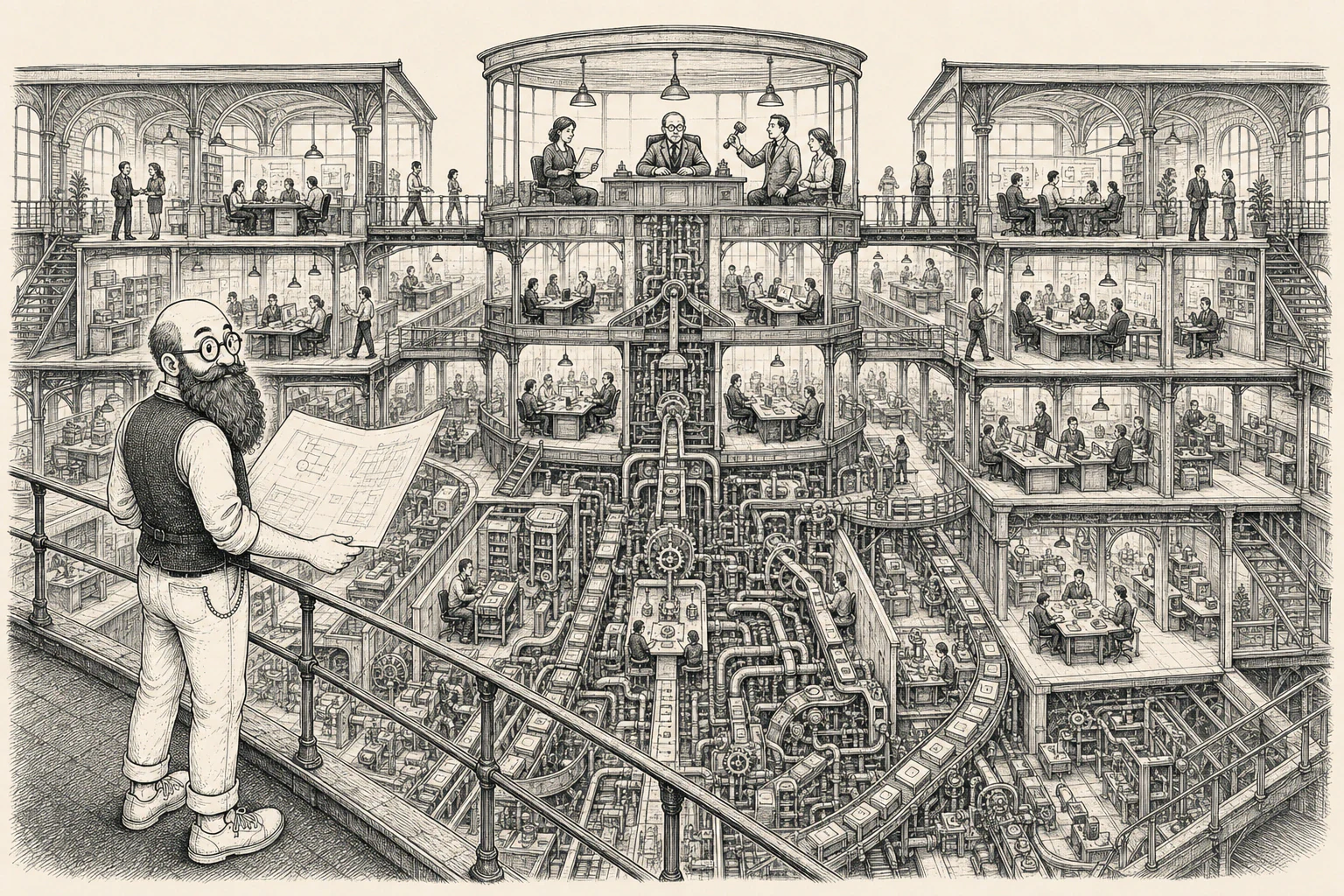
The Structure
This is not one giant AI agent placed in charge of the company.
The architecture is built from smaller layers. A Capability Bundle handles one kind of work. A Role System organizes the work of one position. A Department System coordinates several roles. The business layer connects the departments.
Because each layer has a clear job, it can be tested, governed, and improved without redesigning the entire business every time something changes.
Company priorities, leadership visibility, governance, and coordination across departments.
Shared standards, trusted information, handoffs, progress, exceptions, and escalation.
The work each position owns, the systems it can use, its boundaries, and its recurring capabilities.
The instructions, information, tools, permissions, and safety rules needed for one kind of recurring work.
The individual instructions, tools, actions, and checks assembled inside each Capability Bundle.
The whole structure depends on Shared Business Meaning · Trustworthy Data · Organized Documents · Reliable Retrieval · Connected Systems · Clear Governance
AI-Ready Foundations
AI cannot repair a weak information foundation by itself. Without one, it may simply help the confusion travel faster.
Meaning
Define important terms, measures, report rules, ownership, and decision context so they mean the same thing across the business.
Structure
Show what data exists, where it comes from, how it connects, and who is responsible for it.
Information
Organize where documents live, how they are described, who can reach them, and what happens to them over time.
Retrieval
Combine exact rules with meaning-based search so people and AI can find useful information while respecting authority and access.
Operating Flow
Priorities, standards, knowledge, permissions, and operating rules move into departments and roles.
Roles and departments return progress, exceptions, risks, and decisions to the people responsible for acting on them.
Teams pass work, information, and updates between roles, systems, and departments.
Start Anywhere Useful
Start with one problem worth solving.
That may mean one Capability Bundle, one high-value Role System, one department, an architecture roadmap, AI-readiness work, or the data foundation beneath it.
Each part can solve a useful problem now and become part of the larger work system later.
Phased Implementation
Begin with work worth making repeatable and build the foundation it requires.
Organize related capabilities around the positions responsible for using them.
Coordinate roles through shared information, clear handoffs, progress updates, exceptions, and escalation.
Connect departments through shared priorities, trustworthy information, leadership visibility, and business-wide coordination.
Architecture Roadmap
Free scoping identifies the likely opportunity and the next sensible step. It does not pretend to map an entire business in one conversation.
For broader work, a paid architecture roadmap can define interviews, department priorities, role inventories, workflows, dependencies, readiness gaps, data and information requirements, connector needs, governance, sequencing, and implementation phases.
Free scoping