Across the team
Employees access the appropriate role and workflow capabilities to complete repeatable work with clearer standards, sources, and handoffs.
AI Operating Models
Isolated automation improves individual tasks. Operating Models improve how work is performed, handed off, governed, and coordinated across positions and departments.
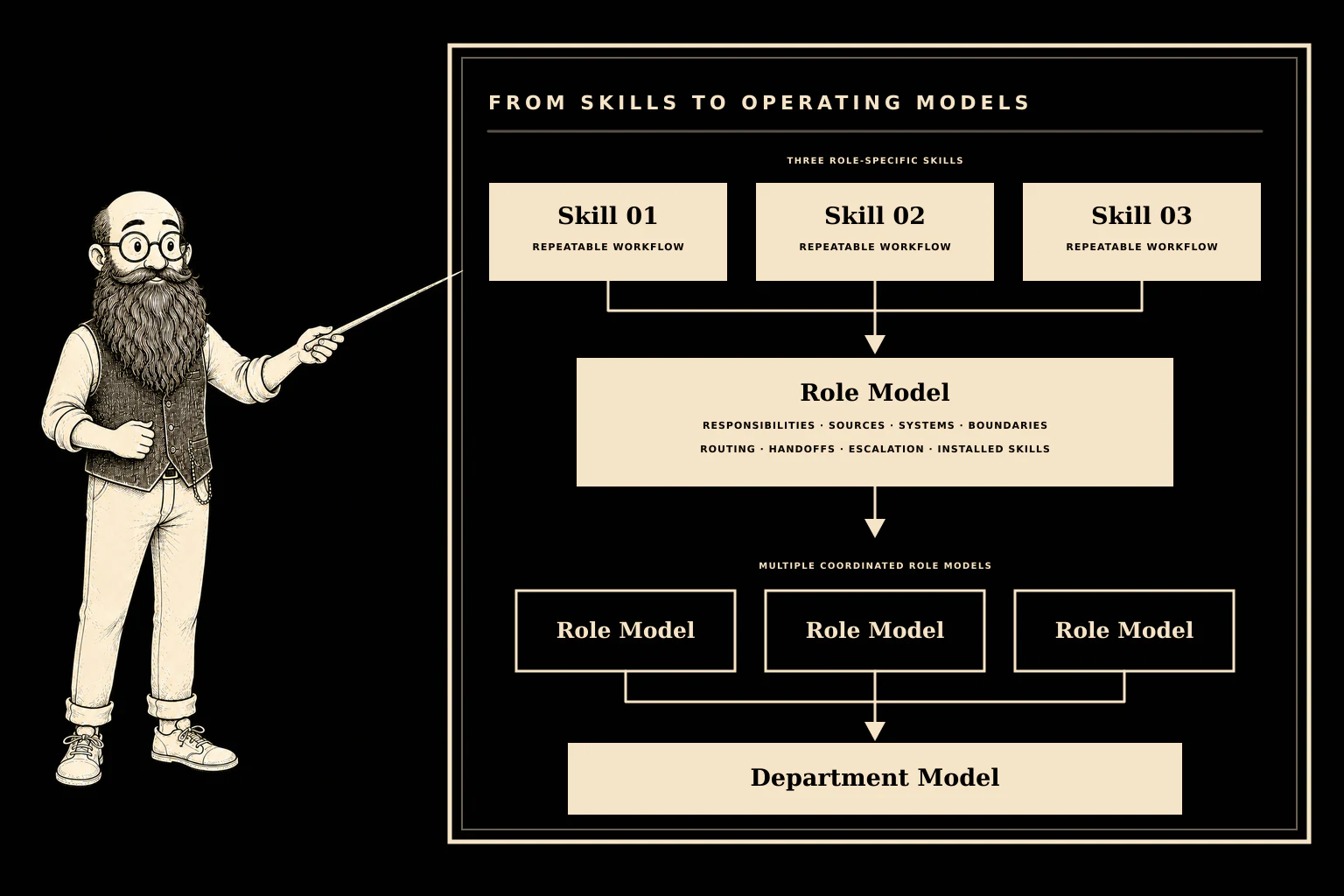
Nornoet composes client-specific AI Skills into Role Models, then coordinates those Role Models through Department Models. Clients can begin with one Skill or one role and expand only when the next layer becomes useful.
AI Skills
An AI Skill converts one repeatable workflow into an executable client-specific capability. It defines the work, approved sources, expected output, operating boundaries, exceptions, escalation rules, and the systems required to perform it.
Explore AI Skills →Role Models
Starting at $10,000 per role
A Role Model is the canonical operating model for one position. It is not merely a chatbot persona, readiness workshop, or role map. The base package connects the role's operating specification to three installed and tested workflow Skills.
The three included Skills are designed together around one role, one discovery process, and one shared operating specification. They are role-specific workflows within that coordinated package, not three separately scoped organization-wide products. Broader standalone capabilities, cross-role workflows, and additional systems are priced separately.
Additional established Skills start at $3,000 each. Novel or specialized workflows are scoped separately.
Employees should not need to memorize exact phrases to use a Role Model. The architecture recognizes equivalent intent, routes the request to the appropriate workflow capability, uses the approved sources and systems, and returns the result within the role's defined boundaries.
Natural-language request → Role and workflow routing → Correct Skill → Approved sources and systems → Governed execution
The role documentation remains the operating source of truth. Skills execute against the same specification instead of carrying inconsistent copies of how the position is supposed to work.
Department Models
Starting at $5,000 for the department layer, plus required Role Models
A Department Model coordinates the roles, standards, knowledge, workflows, and outcomes of one department. It provides the layer that isolated Role Models cannot provide by themselves: shared operation.
Each required Role Model starts at $10,000 and includes three role-specific workflow Skills.
The Operating Outcome
The architecture can help existing teams handle more work, reduce manual coordination, preserve continuity, and give leadership better operational visibility.
The architecture does not make staffing decisions or presume autonomous job replacement. Nornoet architects capacity. The client decides how to use it.
Employees access the appropriate role and workflow capabilities to complete repeatable work with clearer standards, sources, and handoffs.
Department leaders interact with the operating model for status, exceptions, priorities, synthesis, escalation, and coordination across roles.
Modular Expansion
Every engagement can remain useful as the organization expands. A Skill purchased today can become part of a Role Model. That Role Model can later connect to a Department Model. Departments can interconnect across the broader organization.
The architecture compounds because the client does not have to throw away the first useful capability to build the next one.
The free assessment identifies the priority workflows, likely model boundary, major dependencies, and whether the work can be scoped directly or requires a deeper paid roadmap.